Monday, September 04, 2006

Lessons from my cat

Millie's a boy with a girl's name. Long story.

But he teaches us a lot about God.

I used to read the Psalms and hear songs where it says, "I seek your face, O God."

It was one of those phrases that just washes over you unless you think about it.

Until one cold night, when Millie wanted to cuddle up in bed. He literally sought my face, tickling my nose with his whiskers in the process.

Why does he like my face? It's probably not as warm as my armpit, or as soft as my belly. But Millie seems to understand how I'm feeling when he looks at my face.

Communicative creature, isn't he?

And I guess that's what we're all about too. Communication. Connection. I've even written about it today on my other blog.

But how often do I forget that my relationship with God is a relationship? Because I deal with information all the time, sometimes I feel the answer to my spiritual needs comes from more information. It's not so.

Just relaxing and realising that I am always in the presence of a Friend is all it takes.

Thursday, August 31, 2006

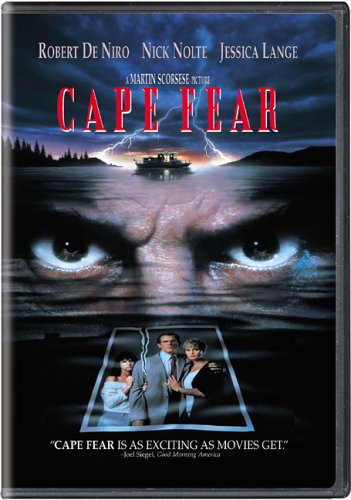
Capes Fear


(Not a misprint; I'm talking in plural, like the womens).

For Marie's psycho studies, we had to analyse several films and get some psychological themes from them.

An ideal assignment! I was glad to offer my two cents with this.

First one was Finding Forrester, the next one was Martin Scorcese's 1991 remake of Cape Fear (1962).

Both of these movies are so well-made, and Scorcese's version (or let's say writer Wesley Strick's version) so deeply layered, that it was very disappointing for me to feel that the story is ultimately unprofitable on a philosophical or personal level.

I guess that's a roundabout way of saying that both Marie and I felt a bit like we'd wasted two good hours after watching this. It was certainly exciting, terrifying, plumbed the depths of the human psyche, but ultimately it had nothing to redeem it, not even a protagonist we can sympathise with.

In the behind-the-scenes featurette, Nick Nolte says that it's about stripping away the masks we wear, and sometimes violent suffering is the only way to do that. I guess so, Nick, but I'd prefer to get that message from a film like Sideways, which does it in a much gentler but still powerful way.

Strick's version of Cape Fear is achingly empty of hope. Danielle's voiceover at the end is a message of stoicism, a message of just pressing on.

From a how-to-make-a-movie department, there were some great touches. Layering the Max Cady character as a psychotic, Bible-quoting avenging angel was an interesting touch that made his character really, really scary, as well as his superhuman strength.

Using the original music from 1962 was inspired, but also made the movie idiosyncratic, perhaps too much for mainstream audiences in 1991. However, Scorcese says it was the movie that earned him the most money of all his films.

Psychological themes aplenty here, though:
  • Fear
  • Obsession
  • Sexuality
  • Repression
  • Deception
  • Dysfunctional families
That's just a few.

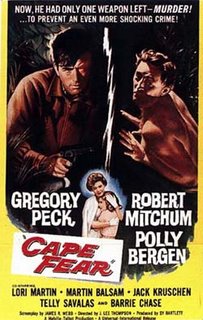
Because we were so dissatisfied with the remake, we thought we'd check out the original. What a difference 30 years makes!

Not that we really liked the original that much, but it's very telling about the acceptable standards of culture at the time. The original can't even say the word "rape", yet the remake shows some pretty gruesome verbal and visual violence (nothing explicit though, except Robert de Niro taking a bite out of Illeana Douglas' cheek).

The original was much simpler and more straightforward than the remake, but the acting was top notch. Robert Mitchum especially is such a great actor. Was, rather. Shame.

However, again with this one I wondered why? It's another entertaining, terrifying wild ride, but at the end the only message I get out of it is that some people are so bad they should be locked in a cage forever. What's so great about that?

Maybe I should stop looking for the transcendent or the uplifting in every movie, and just see how well they've designed their roller-coaster ride. However, knowing a tiny bit about how hard it is to make a movie, I really wonder what's in some people's heads who just go crazy over this sort of story.

Sunday, August 27, 2006

Politics and Christians

I don't understand why so-called liberal people, who would no doubt like to be thought of as open-minded, have only one category for evangelical Christians: people like George W Bush.

Over on the Journz email list that I'm part of, the conversation steered towards the current debate in NZ schools about religion vs. spirituality. It didn't take long before the discussion turned towards state religion, and fear and loathing of evangelicals.

On the one hand, they have a point. Christians have a bad track record when you give us power. Point taken.

On the other hand, I asked people to explain their fear and loathing of Christians - particularly ones who take the Bible literally, particularly if they come from America.

It makes me mad - but that's not likely to help.

My theory is, most of these people - and I'm generalising here - have some form of Christian background. May have been Sunday School lessons as a child, or a Christian grandparent, or whatever.

Whatever their exposure to cultural Christianity, they feel it is a thorough enough exploration of the faith and therefore warrants no further investigation. Their early experiences - often unpleasant - effectively immunises them against the true gospel.

What's the true Gospel? How long have you got?

Seriously, though, I've come to realise that while doctrine is fairly important here, what's most important is to see the message incarnated. Lived out by a real person. Otherwise it makes very little sense.

I'm helped in understanding this emergent viewpoint by What's So Amazing About Grace, particularly its chapter on Christians in politics. Some quotes:

"The church... is not the master or servant of the state, but rather the conscience of the state. It must be the guide and the critic of the state, and never its tool."
Martin Luther King, Jr.

"A coziness between church and state is good for the state and bad for the church."
G.K.Chesterton
So my sense of mission this week - every week - is to seek opportunities to courageously live out my faith, choosing actions that will be backed up by the words of God.

Christianity & Islam - religions of peace?

I often hear people - Muslim and non-Muslim - saying that Islam should not be judged by its extremists like Osama bin Laden, any more than Christians should be judged by the Crusades, the Inquisitions or even the current US Government.

Is that a fair comparison? This article in Christianity Today draws on primarily Islamic scholarship to contrast the two belief systems' approach to war.

Thursday, August 24, 2006

Sex-crazed culture

Breasts are wonderful things. But the main street of Auckland's largest city is not really an appropriate place for them.

What's strange is the overwhelmingly good publicity the mainstream media has given the "Boobs on Bikes" parade. From the NZ Herald to Newstalk ZB, the coverage has been nominally neutral, but has made opposition to the parade sound hypocritical. This interview with city councillor Noeleen Raffils makes her sound stupid (although she didn't help much by citing an anecdote that seemed irrelevant), and then a follow-up interview with parade organiser Steve Crow is on very friendly terms.

People talked about the parade as if it weren't linked into the Erotica Lifestyles Expo, a promotional tool for the porn industry. Steve Crow is full of it when he talks about freedom of speech. Porn is not about freedom of choice any more than smoking is about freedom of choice. You choose to get in, and it's a very hard choice to get out.

Instead of championing the Larry Flynts and Steve Crows of this world, let's recognise them for what they are: misled people misleading others to indulge their desires and fulfil their needs in an inappropriate way. Their attempts to normalise porn makes a mockery of the sacredness of sex and sexuality. Why don't we see this?

Monday, August 21, 2006

Who says no one goes to church?

Who says no one goes to church? - an interesting article from Challenge Weekly.

Particularly sad and interesting was this quote:

"Wayne Kirkland, of Signpost Communications, says there is little doubt that people are responding to Jesus’ invitation to be his disciples.

“However, for every one of these new disciples, perhaps six or seven others have either failed to become established or have dropped out after some time. Regardless of how many of these ‘dropouts’ were ‘genuinely converted’ in the first place, we have a tragedy of major proportions.

“Thousands of New Zealanders are tasting something of Christianity and rejecting it. Thus, thousands are becoming inoculated against genuine attempts to reach them in the future.”


That's echoing the thoughts going through my head about how many people don't get a chance to really know what the Gospel is really about; instead, they get exposed to something that is close enough to fool an outside observer, but lacks the credibility which the 1st century Gospel had.

It's not because the Gospel's changed, it's just that its proponents - people like me - have not lived out the Message in all its fulness.

Wednesday, August 16, 2006

What is Worldview?


I recently bought a copy of Chuck Colson and Nancy Pearsey's How Now Shall We Live? It's all about worldview, a term I used to hear frequently during my time in Christian radio. I never gave it much thought back then, because I was working with people whose worldview is similar to mine.
In recent years as I got more philosophical in my thinking, I resisted the idea of learning a "Christian worldview". It sounded like brainwashing, sort of, "you can't think for yourself, let us tell you what The Church thinks about this, and don't bother thinking for yourself."

But that's an easy caricature to paint, and one that plays into the hands of a secular humanistic worldview, which is often just as dogmatic.

Instead, I've discovered a need, a hunger in myself to know what a Biblical worldview is. Why can't I just read the Bible and figure it out for myself? Well, I could, but it might take my whole life. Why not stand on the shoulders of others, and get a bigger picture?

For me, worldview is about connecting the dots. I know where I stand on issues like abortion, marriage and homosexuality. But how about the areas I regularly write about for a living, like marketing, technology and business?

I can form my own opinions, but reading on worldview helps guide my thinking. It's not about dictating, but it is about presenting the evidence so I can decide.

I haven't started the book yet; I'll let you know how it goes!

Monday, July 31, 2006

Let's talk about sex

Our sexuality is central to who we are, so it's no wonder that the media and advertising uses it so much to get our attention.

Well, Christians are no different from the rest of the world in that respect, and I was part of a packed house at the Church of the Holy Sepulchre on Saturday to talk about sex - specifically healing from sexual brokenness - at a meeting organised by Living Waters NZ.

It's so encouraging that there are many people willing to discuss this whole issue at the core of who we are, openly.

More later on this, but I was really really challenged by the words of Tony Dolph-something (my apologies, can't find his name and I didn't write it down properly).

He said we buy into the world's way of thinking when we seek happiness as the highest good. God never calls us to happiness necessarily, but to a relationship with Him.

When I put it like that it seems very bald and unattractive, but at the time it was very compelling. And still is; I just struggle to explain what a profound change of my thinking this represents.

Like I say, more on this later.

Tuesday, July 25, 2006

So someone reads this!

I got an email from someone who actually reads this! Wow. And not just someone, the editor of NZ Netguide, Nige Horrocks.

Made my day, and encouraged me to post again. But what to write about...?

It's not like there's not a lot going on on the spiritual front - in fact God's very busy doing stuff in me... but where to start?

I'll start with what I'm reading right now: What's so amazing about grace?

It's a classic. When I was working at Rhema many years ago I heard about it all the time, yet I haven't read it. Until now.

It's good, very good. Re-emphasising the lessons on God's grace - which is a word in danger of losing its meaning, because when you understand grace, it is crazy. It is amazing.

That's it for now, tune in next time for more...

Monday, July 10, 2006

Thoughts on truth


I recently finished partly reading Why Truth Matters, an exhausting philosophical look at why our society urgently needs objective truth.

What puzzled me was that I was reading familiar arguments for absolute objective truth, from a secular humanistic point of view.

Tres strange!

In particular this quote caught my attention:

"...[E]nquiry, curiosity, interest, investigation, explanation-seeking, are hugely important components of human happiness. This doesn't seem to be a terribly popular thought right now. Public rhetoric tends to aim much lower, for some reason. It seems to see us all as hunkered down, and settling. Settling for minimal, parochial, almost biological satisfactions - family, safety, money. But that underestimates us. We want more than that. We want to ask questions, we want to learn, we want to understand. That's a very human taste and pleasure. ... It seems a waste not to use human capacities and abilities. Anyone can settle for just survival and reproduction and comfort, but we can do more. That's a privilege - and it seems a kind of sacrilege not to use it."


They're facing the same problem faced by philosophers in the 19th century. Remove God from the equation, you can do that with your head, but your heart still wants something sacred. And if you're removed the source of all sacredness, all you have are more questions. And questions only get you so far.