Monday, November 13, 2006

Walkies


Got some fancy new shoes on the weekend after my other ones fell to pieces. They're nice - they measured my feet and how I stood beforehand. Good feeling, knowing you're stepping into something that's made for you.

Made me think about how the Christian life is referred to as a walk. It takes persistence, but it also means God has prepared my path. I don't know if He's given me cushioned soles though!

Wednesday, November 08, 2006

What repentance looks like

You can read Ted Haggard's apology to his congregation here.

I didn't know much about Ted Haggard except that he was high profile in the US Christian community and also featured in Jesus Camp.

It was really sad to hear of another Christian leader's fall, and hypocrisy. Sad because of the harm it does to Christianity's image, but sad too because it makes me think of the things not yet sorted in my life. There but for the grace of God go I - even if not in the same way.

But what gives me hope is the truly repentant tone of Haggard's letter. There is no PR spin here, nor is there deflection of blame. This is what repentance looks like, and although it's scandalous that this has happened at such a high level of leadership and therefore responsibility, truth is we are all very broken people. It'll be interesting to see the church's response to this, although at the same time that's best kept behind closed doors and not made into a media circus.

Interesting and insightful analysis from Gordon McDonald here.

Saturday, November 04, 2006

Quote

Just spring-cleaning my desk and found a quote I'd scribbled down. I don't remember who said it but it was a guest on In the Studio with Michael Card:

"We wouldn't know Him (God) for all that He is, if we didn't see Him in and through all that He made."

Thursday, November 02, 2006

More thoughts on "The New Atheism"

Continuing from the last post, a few more thoughts.

"Everything you hinge your life upon is false"
According to the article, a lot of self-identified agnostics are really "polite atheists" who are shy of declaring their atheism because, in effect, it says to their believing friends: "Everything you hinge your life upon is false."

That may seem a bit on the nose, but it didn't faze me. Because, in effect, that's what I'm doing to people with a naturalistic worldview when I present Christianity - real Christianity - as a coherent, rational worldview with moral consequences. That's why I don't present it unsolicited too often - because if it's real, sorry, if Christ is real, then He will change your whole life and belief system, not just become an add-on to your life.

Yet how many people have not heard this? They make a commitment expecting it to be X, and then hear later that it's supposed to be Y. No wonder it's hard going for some, and many have been turned off church forever.

Why Wired?
I heard an excellent podcast (which I got through iTunes' feed, and can't find on Wired's podcast blog!) in which Wired's managing editor (I think?) interviewed Gary Wolf, the author of the article. In it, the managing editor asked, "Why is this a Wired article?"

Wolf answered along the lines that the Wired economy is built on technology, which in turn is built on science, and that these Intelligent Design people are standing in the way of true science.

It's an easy statement to make, but it's utter bollocks.

Another podcast I've been listening to, Intelligent Design the Future, seems to be a lone voice trying to remind the media that:
  • Intelligent design is as fair a conclusion to draw from nature as evolution
  • Scientists who believe in ID are still scientists
  • Intelligence in design doesn't necessarily mean the designer is supernatural
  • These scientists often face censure from their colleagues for not toeing the Darwinist line
  • It's Galileo all over again, but this time the Darwinist majority takes the place of the Catholic Church, getting really mad with those who dispute their dogma
On that third point, intelligence in design doesn't necessarily mean the designer is supernatural, sometimes words get in the way of real understanding.

If you're an atheist or an agnostic reading this, how about we substitute the word "supernatural" with "extradimensional"? Does that make the picture any more plausible to your scientific understanding?

Tuesday, October 31, 2006

Interesting article on "The New Atheism"

A very thought-provoking read from Wired Magazine on "The New Atheism". I admire the author's honesty with the shortcomings of the anti-faith and its proponents. As expected, the article didn't go very deep into the "other side", instead simply paying a visit to a charismatic, not very intellectually rigorous church.

Still, even with that, this article doesn't give me cause to worry about my faith. The logic is impeccable - if God is not real, then don't act like God is real, be an atheist. And the counterargument should give religious people food for thought: if God is real, live like it, don't just play at it.

People like Dawkins pour scorn on agnosticism, yet I believe agnosticism is also a viable, if uncomfortable, place to be. I'm realising myself that, as Henry Blackaby says in Experiencing God: Knowing and Doing His Will, Truth is revealed, not discovered. I'm learning stuff in the past few weeks that I thought I knew for 15 years.
Ultimately, my personal argument against atheism is my relationship with my Creator. It's not empirically verifiable, and that's okay. But it is something I need to walk out every day, otherwise I undermine what I'm saying here.

Thursday, October 26, 2006

The world's best-selling book, minus the main character

I think modern, secular Western culture doesn't quite know what to do with God. We have two millennia of Christianity's undeniable influence and yet, in intellectual circles anyway, we have banished him or explained him away.

Perhaps this is part of the thinking behind The Honey and the Fires: Ancient Stories retold for our Times.

It's "a modern, secular retelling of some of the most powerful stories from the Bible", according to its publisher the ABC.

On one hand, I'm pleased. People who may otherwise ignore the immense spiritual and cultural heritage available in the Bible will get a glimpse of the exciting tales told between its covers.

On the other hand, something very important is missing here. God!

It begs the question: can you have the Bible without God? And in many places the author, playwright Roger Pulver, does a beautiful God. But the heroes of the Bible included here: Joseph, Daniel, Esther ... all did their acts of courage because of a belief and a relationship with their Creator.

Mixed feelings. But the best thing you can say about anything is that it makes you think. It makes me think, how often have I tried to live life without God - it appears a lot less complicated, after all!

But inevitably his Reality comes crashing into my life, full of grace and mercy. And I wouldn't have it any other way.

Saturday, October 14, 2006

Checking in: cartoons, PK, and Worldview

Just a brief hello, more to come soon (hopefully!)

I've finished Derek Prince's War in Heaven (review to come), read and finished Arthur Katz' Ben Israel - veeeeeery interesting - been to Promise Keepers, and begun reading How Now Shall We Live? Also very interesting.

I also met Brendan aka Jim the cartoonist at a recent PR event. Lots of overlapping experiences and different perspectives - hope to keep in touch with him regularly.

Tuesday, September 05, 2006

Fodder for Christian writers and artists

Some food for thought for Christians who want to write and create art that touches people of all persuasions.

First up, an interview with screenwriter and professor Craig Detweiler about film, and a 2-part interview with CS Lewis, possibly the last he ever gave, here and here.

Some gems:

What lessons would you most like to see Christian filmmakers learn?

Detweiler: We surely don't need any more End Times films. We don't need any more films that mean what they say and say what they mean. I think we have to discover the lost art of subtlety and subtext.

At Biola, we start our filmmakers with visual aesthetics. We let them know that film is not meant to be an illuminated Bible. This is an art form that is visual by design. It does not need words to convey the message. What I'd like us to do is figure out what lighting, sound, color, props, and set design say. I'd like us to discover the power of silent film, to discover how Dreyer's The Passion of Joan of Arc worked and continues to work, how Sunrise continues to work, how The Last Laugh continues to work.

---


Wirt: Can you suggest an approach that would spark the creation of a body of Christian literature strong enough to influence our generation?

Lewis: There is no formula in these matters. I have no recipe, no tablets. Writers are trained in so many individual ways that it is not for us to prescribe. Scripture itself is not systematic; the New Testament shows the greatest variety. God has shown us that he can use any instrument. Balaam’s ass, you remember, preached a very effective sermon in the midst of his ‘hee-haws.’


---

Lewis: There is a character in one of my children’s stories named Aslan, who says, ‘I never tell anyone any story except his own.’ I cannot speak for the way God deals with others; I only know how he deals with me personally


---

Wirt: Do you believe that the Holy Spirit can speak to the world through Christian writers today?

Lewis: “I prefer to make no judgment concerning a writer’s direct ‘illumination’ by the Holy Spirit. I have no way of knowing whether what is written is from heaven or not. I do believe that God is the Father of lights -- natural lights as well as spiritual lights (James 1:17). That is, God is not interested only in Christian writers as such. He is concerned with all kinds of writing. In the same way a sacred calling is not limited to ecclesiastical functions. The man who is weeding a field of turnips is also serving God.”

Prayer in Parliament

I was checking out TVNZ's live Parliament video feed the other day, and was taken aback by the beautiful words of the prayer uttered when Parliament begins:

Almighty God, humbly acknowledging our need for thy guidance in all things, and laying aside all private and personal interests, we beseech thee to grant that we may conduct the affairs of this House and of our country to the glory of thy holy name, the maintenance of true religion and justice, the honour of the Queen and the public welfare, peace and tranquillity of New Zealand, through Jesus Christ our Lord. Amen.
Wouldn't that be a fantastic prayer to pray, if people meant it?

I was also surprised at the explicit reference to Jesus Christ. This is a deity-specific prayer, as opposed to the usual "Oh my God" you may hear sometimes.

Apparently, there's a move afoot to remove Christ's name from the prayer, and predictably there's opposition, as this article details.

It's an interview with David Major, who's had a lot of influence in the political world. A quote:
In the 1990s Mr. Major was chief executive of the National Party under Prime Ministers Jim Bolger and Jenny Shipley. He said saying grace was a regular feature of dinner parties at Premier House, whereas now grace was not even said at a state banquet.

“All that’s come to a halt, and we’ve let it happen.”
I'm concerned at this attitude. As Christians, shouldn't we be more concerned that the prayer is being spoken and assented to by people who mostly don't have any relationship with God? Isn't that taking the Lord's name in vain?

So if there's a move to take Christ's name out of the official prayer, I would support it. Sadly, because the ideal is that everyone may know Christ for who He really is. But sadly, I suspect all this prayer will remind people of is New Zealand's historical roots, and a religion that used to make sense.

Monday, September 04, 2006

Lessons from my cat

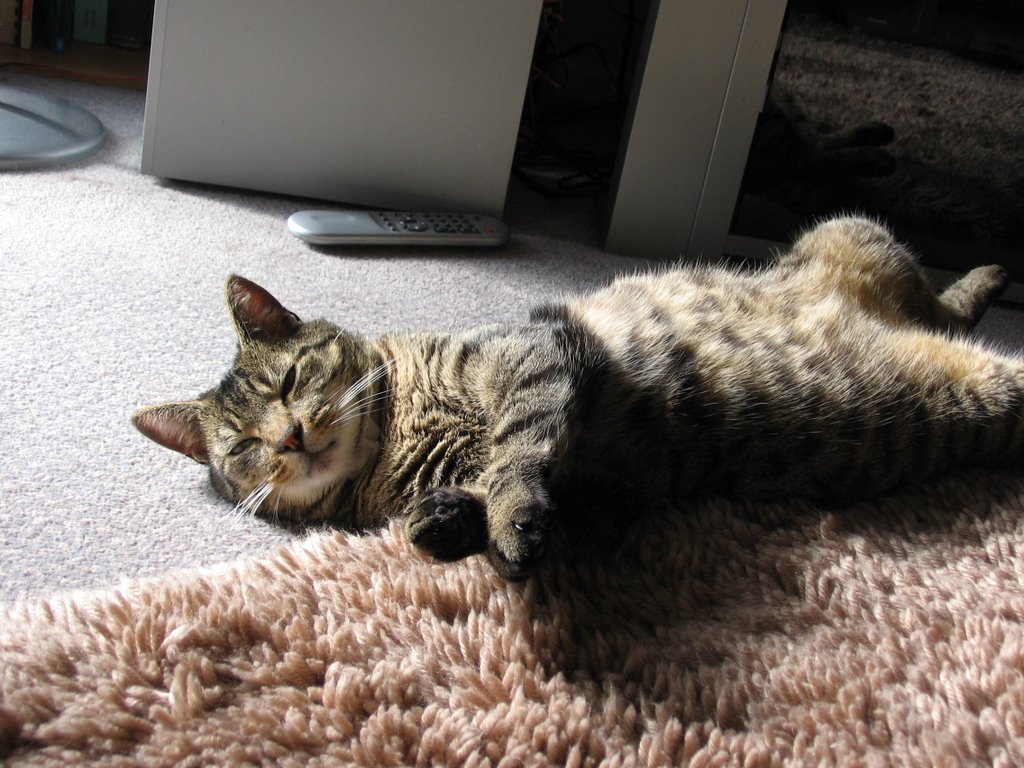
Millie's a boy with a girl's name. Long story.

But he teaches us a lot about God.

I used to read the Psalms and hear songs where it says, "I seek your face, O God."

It was one of those phrases that just washes over you unless you think about it.

Until one cold night, when Millie wanted to cuddle up in bed. He literally sought my face, tickling my nose with his whiskers in the process.

Why does he like my face? It's probably not as warm as my armpit, or as soft as my belly. But Millie seems to understand how I'm feeling when he looks at my face.

Communicative creature, isn't he?

And I guess that's what we're all about too. Communication. Connection. I've even written about it today on my other blog.

But how often do I forget that my relationship with God is a relationship? Because I deal with information all the time, sometimes I feel the answer to my spiritual needs comes from more information. It's not so.

Just relaxing and realising that I am always in the presence of a Friend is all it takes.