Tuesday, October 31, 2006

Interesting article on "The New Atheism"

A very thought-provoking read from Wired Magazine on "The New Atheism". I admire the author's honesty with the shortcomings of the anti-faith and its proponents. As expected, the article didn't go very deep into the "other side", instead simply paying a visit to a charismatic, not very intellectually rigorous church.

Still, even with that, this article doesn't give me cause to worry about my faith. The logic is impeccable - if God is not real, then don't act like God is real, be an atheist. And the counterargument should give religious people food for thought: if God is real, live like it, don't just play at it.

People like Dawkins pour scorn on agnosticism, yet I believe agnosticism is also a viable, if uncomfortable, place to be. I'm realising myself that, as Henry Blackaby says in Experiencing God: Knowing and Doing His Will, Truth is revealed, not discovered. I'm learning stuff in the past few weeks that I thought I knew for 15 years.

Ultimately, my personal argument against atheism is my relationship with my Creator. It's not empirically verifiable, and that's okay. But it is something I need to walk out every day, otherwise I undermine what I'm saying here.

Thursday, October 26, 2006

The world's best-selling book, minus the main character

I think modern, secular Western culture doesn't quite know what to do with God. We have two millennia of Christianity's undeniable influence and yet, in intellectual circles anyway, we have banished him or explained him away.

Perhaps this is part of the thinking behind The Honey and the Fires: Ancient Stories retold for our Times.

It's "a modern, secular retelling of some of the most powerful stories from the Bible", according to its publisher the ABC.

On one hand, I'm pleased. People who may otherwise ignore the immense spiritual and cultural heritage available in the Bible will get a glimpse of the exciting tales told between its covers.

On the other hand, something very important is missing here. God!

It begs the question: can you have the Bible without God? And in many places the author, playwright Roger Pulver, does a beautiful God. But the heroes of the Bible included here: Joseph, Daniel, Esther ... all did their acts of courage because of a belief and a relationship with their Creator.

Mixed feelings. But the best thing you can say about anything is that it makes you think. It makes me think, how often have I tried to live life without God - it appears a lot less complicated, after all!

But inevitably his Reality comes crashing into my life, full of grace and mercy. And I wouldn't have it any other way.

Saturday, October 14, 2006

Checking in: cartoons, PK, and Worldview

Just a brief hello, more to come soon (hopefully!)

I've finished Derek Prince's War in Heaven (review to come), read and finished Arthur Katz' Ben Israel - veeeeeery interesting - been to Promise Keepers, and begun reading How Now Shall We Live? Also very interesting.

I also met Brendan aka Jim the cartoonist at a recent PR event. Lots of overlapping experiences and different perspectives - hope to keep in touch with him regularly.

Tuesday, September 05, 2006

Fodder for Christian writers and artists

Some food for thought for Christians who want to write and create art that touches people of all persuasions.

First up, an interview with screenwriter and professor Craig Detweiler about film, and a 2-part interview with CS Lewis, possibly the last he ever gave, here and here.

Some gems:

What lessons would you most like to see Christian filmmakers learn?

Detweiler: We surely don't need any more End Times films. We don't need any more films that mean what they say and say what they mean. I think we have to discover the lost art of subtlety and subtext.

At Biola, we start our filmmakers with visual aesthetics. We let them know that film is not meant to be an illuminated Bible. This is an art form that is visual by design. It does not need words to convey the message. What I'd like us to do is figure out what lighting, sound, color, props, and set design say. I'd like us to discover the power of silent film, to discover how Dreyer's The Passion of Joan of Arc worked and continues to work, how Sunrise continues to work, how The Last Laugh continues to work.

---


Wirt: Can you suggest an approach that would spark the creation of a body of Christian literature strong enough to influence our generation?

Lewis: There is no formula in these matters. I have no recipe, no tablets. Writers are trained in so many individual ways that it is not for us to prescribe. Scripture itself is not systematic; the New Testament shows the greatest variety. God has shown us that he can use any instrument. Balaam’s ass, you remember, preached a very effective sermon in the midst of his ‘hee-haws.’


---

Lewis: There is a character in one of my children’s stories named Aslan, who says, ‘I never tell anyone any story except his own.’ I cannot speak for the way God deals with others; I only know how he deals with me personally


---

Wirt: Do you believe that the Holy Spirit can speak to the world through Christian writers today?

Lewis: “I prefer to make no judgment concerning a writer’s direct ‘illumination’ by the Holy Spirit. I have no way of knowing whether what is written is from heaven or not. I do believe that God is the Father of lights -- natural lights as well as spiritual lights (James 1:17). That is, God is not interested only in Christian writers as such. He is concerned with all kinds of writing. In the same way a sacred calling is not limited to ecclesiastical functions. The man who is weeding a field of turnips is also serving God.”

Prayer in Parliament

I was checking out TVNZ's live Parliament video feed the other day, and was taken aback by the beautiful words of the prayer uttered when Parliament begins:

Almighty God, humbly acknowledging our need for thy guidance in all things, and laying aside all private and personal interests, we beseech thee to grant that we may conduct the affairs of this House and of our country to the glory of thy holy name, the maintenance of true religion and justice, the honour of the Queen and the public welfare, peace and tranquillity of New Zealand, through Jesus Christ our Lord. Amen.
Wouldn't that be a fantastic prayer to pray, if people meant it?

I was also surprised at the explicit reference to Jesus Christ. This is a deity-specific prayer, as opposed to the usual "Oh my God" you may hear sometimes.

Apparently, there's a move afoot to remove Christ's name from the prayer, and predictably there's opposition, as this article details.

It's an interview with David Major, who's had a lot of influence in the political world. A quote:
In the 1990s Mr. Major was chief executive of the National Party under Prime Ministers Jim Bolger and Jenny Shipley. He said saying grace was a regular feature of dinner parties at Premier House, whereas now grace was not even said at a state banquet.

“All that’s come to a halt, and we’ve let it happen.”
I'm concerned at this attitude. As Christians, shouldn't we be more concerned that the prayer is being spoken and assented to by people who mostly don't have any relationship with God? Isn't that taking the Lord's name in vain?

So if there's a move to take Christ's name out of the official prayer, I would support it. Sadly, because the ideal is that everyone may know Christ for who He really is. But sadly, I suspect all this prayer will remind people of is New Zealand's historical roots, and a religion that used to make sense.

Monday, September 04, 2006

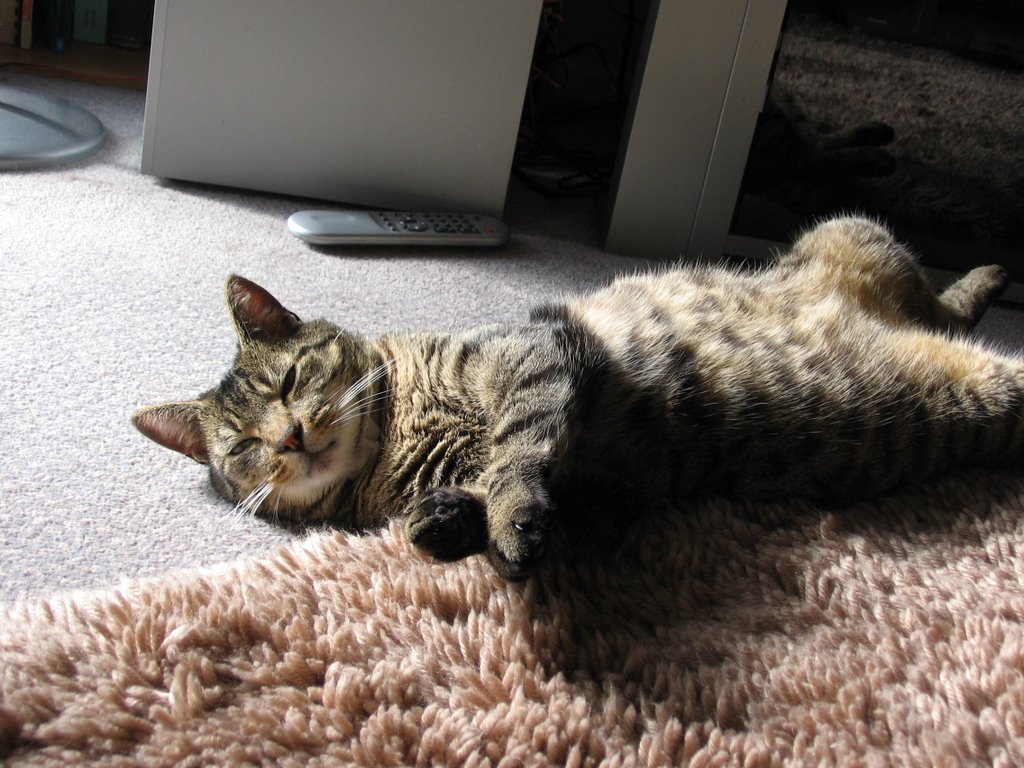
Lessons from my cat

Millie's a boy with a girl's name. Long story.

But he teaches us a lot about God.

I used to read the Psalms and hear songs where it says, "I seek your face, O God."

It was one of those phrases that just washes over you unless you think about it.

Until one cold night, when Millie wanted to cuddle up in bed. He literally sought my face, tickling my nose with his whiskers in the process.

Why does he like my face? It's probably not as warm as my armpit, or as soft as my belly. But Millie seems to understand how I'm feeling when he looks at my face.

Communicative creature, isn't he?

And I guess that's what we're all about too. Communication. Connection. I've even written about it today on my other blog.

But how often do I forget that my relationship with God is a relationship? Because I deal with information all the time, sometimes I feel the answer to my spiritual needs comes from more information. It's not so.

Just relaxing and realising that I am always in the presence of a Friend is all it takes.

Thursday, August 31, 2006

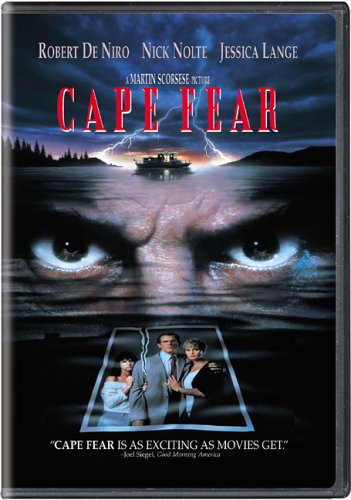
Capes Fear


(Not a misprint; I'm talking in plural, like the womens).

For Marie's psycho studies, we had to analyse several films and get some psychological themes from them.

An ideal assignment! I was glad to offer my two cents with this.

First one was Finding Forrester, the next one was Martin Scorcese's 1991 remake of Cape Fear (1962).

Both of these movies are so well-made, and Scorcese's version (or let's say writer Wesley Strick's version) so deeply layered, that it was very disappointing for me to feel that the story is ultimately unprofitable on a philosophical or personal level.

I guess that's a roundabout way of saying that both Marie and I felt a bit like we'd wasted two good hours after watching this. It was certainly exciting, terrifying, plumbed the depths of the human psyche, but ultimately it had nothing to redeem it, not even a protagonist we can sympathise with.

In the behind-the-scenes featurette, Nick Nolte says that it's about stripping away the masks we wear, and sometimes violent suffering is the only way to do that. I guess so, Nick, but I'd prefer to get that message from a film like Sideways, which does it in a much gentler but still powerful way.

Strick's version of Cape Fear is achingly empty of hope. Danielle's voiceover at the end is a message of stoicism, a message of just pressing on.

From a how-to-make-a-movie department, there were some great touches. Layering the Max Cady character as a psychotic, Bible-quoting avenging angel was an interesting touch that made his character really, really scary, as well as his superhuman strength.

Using the original music from 1962 was inspired, but also made the movie idiosyncratic, perhaps too much for mainstream audiences in 1991. However, Scorcese says it was the movie that earned him the most money of all his films.

Psychological themes aplenty here, though:
  • Fear
  • Obsession
  • Sexuality
  • Repression
  • Deception
  • Dysfunctional families
That's just a few.

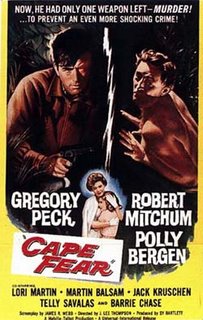
Because we were so dissatisfied with the remake, we thought we'd check out the original. What a difference 30 years makes!

Not that we really liked the original that much, but it's very telling about the acceptable standards of culture at the time. The original can't even say the word "rape", yet the remake shows some pretty gruesome verbal and visual violence (nothing explicit though, except Robert de Niro taking a bite out of Illeana Douglas' cheek).

The original was much simpler and more straightforward than the remake, but the acting was top notch. Robert Mitchum especially is such a great actor. Was, rather. Shame.

However, again with this one I wondered why? It's another entertaining, terrifying wild ride, but at the end the only message I get out of it is that some people are so bad they should be locked in a cage forever. What's so great about that?

Maybe I should stop looking for the transcendent or the uplifting in every movie, and just see how well they've designed their roller-coaster ride. However, knowing a tiny bit about how hard it is to make a movie, I really wonder what's in some people's heads who just go crazy over this sort of story.

Sunday, August 27, 2006

Politics and Christians

I don't understand why so-called liberal people, who would no doubt like to be thought of as open-minded, have only one category for evangelical Christians: people like George W Bush.

Over on the Journz email list that I'm part of, the conversation steered towards the current debate in NZ schools about religion vs. spirituality. It didn't take long before the discussion turned towards state religion, and fear and loathing of evangelicals.

On the one hand, they have a point. Christians have a bad track record when you give us power. Point taken.

On the other hand, I asked people to explain their fear and loathing of Christians - particularly ones who take the Bible literally, particularly if they come from America.

It makes me mad - but that's not likely to help.

My theory is, most of these people - and I'm generalising here - have some form of Christian background. May have been Sunday School lessons as a child, or a Christian grandparent, or whatever.

Whatever their exposure to cultural Christianity, they feel it is a thorough enough exploration of the faith and therefore warrants no further investigation. Their early experiences - often unpleasant - effectively immunises them against the true gospel.

What's the true Gospel? How long have you got?

Seriously, though, I've come to realise that while doctrine is fairly important here, what's most important is to see the message incarnated. Lived out by a real person. Otherwise it makes very little sense.

I'm helped in understanding this emergent viewpoint by What's So Amazing About Grace, particularly its chapter on Christians in politics. Some quotes:

"The church... is not the master or servant of the state, but rather the conscience of the state. It must be the guide and the critic of the state, and never its tool."
Martin Luther King, Jr.

"A coziness between church and state is good for the state and bad for the church."
G.K.Chesterton
So my sense of mission this week - every week - is to seek opportunities to courageously live out my faith, choosing actions that will be backed up by the words of God.

Christianity & Islam - religions of peace?

I often hear people - Muslim and non-Muslim - saying that Islam should not be judged by its extremists like Osama bin Laden, any more than Christians should be judged by the Crusades, the Inquisitions or even the current US Government.

Is that a fair comparison? This article in Christianity Today draws on primarily Islamic scholarship to contrast the two belief systems' approach to war.

Thursday, August 24, 2006

Sex-crazed culture

Breasts are wonderful things. But the main street of Auckland's largest city is not really an appropriate place for them.

What's strange is the overwhelmingly good publicity the mainstream media has given the "Boobs on Bikes" parade. From the NZ Herald to Newstalk ZB, the coverage has been nominally neutral, but has made opposition to the parade sound hypocritical. This interview with city councillor Noeleen Raffils makes her sound stupid (although she didn't help much by citing an anecdote that seemed irrelevant), and then a follow-up interview with parade organiser Steve Crow is on very friendly terms.

People talked about the parade as if it weren't linked into the Erotica Lifestyles Expo, a promotional tool for the porn industry. Steve Crow is full of it when he talks about freedom of speech. Porn is not about freedom of choice any more than smoking is about freedom of choice. You choose to get in, and it's a very hard choice to get out.

Instead of championing the Larry Flynts and Steve Crows of this world, let's recognise them for what they are: misled people misleading others to indulge their desires and fulfil their needs in an inappropriate way. Their attempts to normalise porn makes a mockery of the sacredness of sex and sexuality. Why don't we see this?